

Central Planning
Social engineering for small birds and larger humans
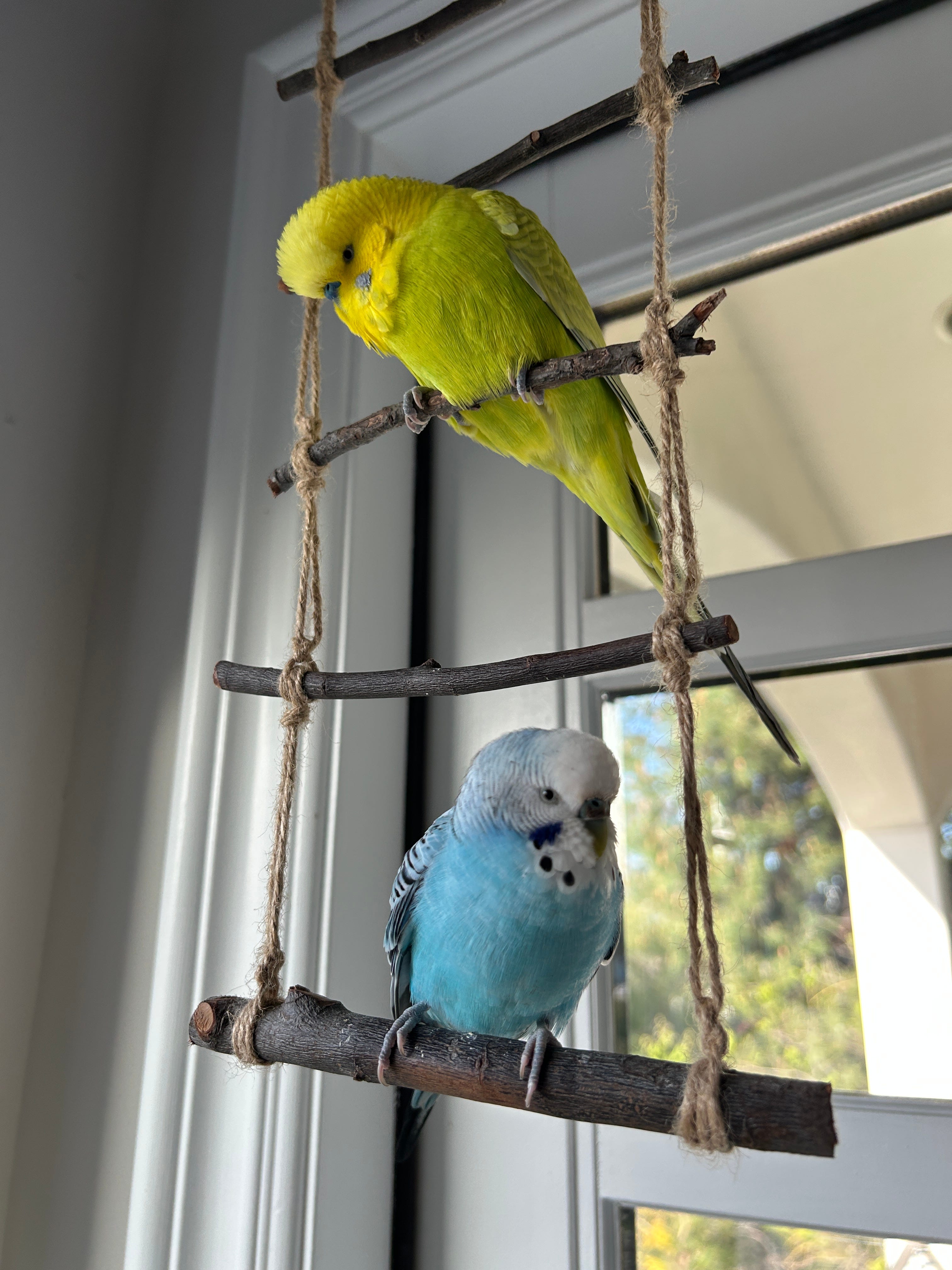
Every month I switch up the layout of my parrots’ cage, which means monthly I observe the effects of central planning upon its constituents. I have a few principles I adhere to (always offer several high branches, rotate out toys, and never place the shredding kabob above the water bowl) but otherwise the arrangement is up to me.
Like any benevolent dictator, I love my subjects very much. I put a lot of care into cage setups–but occasionally, I miss. My biggest failure was when I divided the cage into two. I installed a natural seagrass mat, which hung from the top of the cage and effectively carved the upper third of it into two chambers. This, I thought, would solve the fifteen seconds every night when Snowy and Banana would hop between each branch, merry-go-round style, to decide which was theirs for the night. Two rooms, two budgies, one in each room, no more confusion.
Wrong!
I thought I created two equal sides, but by budgie standards, one side was clearly more desirable than the other. No matter how much I tinkered around with the setup of the objectionable side, I could never increase its value, and every bedtime started off with a now lengthy bicker over who got the bird equivalent of the king sized bed. Banana, by virtue of being a whopping 12 grams heavier than Snowy (a 30% difference) always won fights over territory. As a result, Snowy went to bed pissed, woke up pissed, and consequently took it out on my finger in the morning.
Of course, nobody is coming into our homes and rearranging our furniture monthly, but this makes me think of how structural conditions can drastically affect our behaviour. Two otherwise sweet birds are goaded into biting tiffs by their cage setup. I’m more lethargic after moving into a condo where morning sunlight is blocked by the neighbouring building. Entire US cities are built for car interaction more than they are for human interaction, an issue no mayor is going to solve by running a more aggressive, can-do campaign.
One answer is to go where the structure favours us. If you’re building a tech startup, then it makes sense to be in the Bay, where there is a concentration of smart, visionary, thoughtful people interested in solving world (or status) problems via tech. But if you’re interested in culture, don’t live in Sunnyvale…
The second is to give the structure feedback. This means incentive alignment between planners and inhabitants and figuring out how to clearly communicate intent. Whenever Snowy and Banana complained about their cage setup via fights, bites, or refusals to go in for bedtime (as a landed animal, you can’t make a flying thing do anything it doesn’t want to), that was a form of feedback.
The third is to become the structure. If you’re a parrot, that entails growing arms and doing the laundry, so that’s a no-go. But if you’re a human, it’s possible to temporarily become a structural setup. That’s why hosting is so powerful: it enables you to set the conditions for interaction and create a magical moment out of the mundane. I’ve done some of my best writing in the presence of friends because our environment of shared striving made creation a natural byproduct.
After the Great Failed Partitioning, I reinvested time into making sure that sleeping branches were equally desirable and accessible rather than erecting artificial walls. Lo and behold, happy parrots. In retrospect, the obvious answer was to take down the seagrass partition as soon as I realized it wasn’t working, rather than wait until the end of the month. I file that under lessons in central planning.
What I’ve been reading:
Really liking Steph Ango’s blog. He’s the CEO of Obsidian, which I would definitely use if I wasn’t grandfathered into Roam Research for free
Seeing Like a Network by Rohit Krishnan on how the market of information has changed
You’re probably a eugenicist by Diana Fleischman which is… quite the title, but a fair and needed conversation
The stable marriage problem by Ajey Cotra. Has anyone tried producing a dating show with the Gale-Shapley algorithm as the core solution? Also, I guess this is the premise of Bumble, where women are the proposers
How does Docusign have 7,000 employees? by Trungphan2 (notably not Trungphan1). Cradling this article to sleep at night as I watch the massive SaaS selloffs
Probably my favorite HJ Zhou piece so far
Another delightful and thoughtful read from you in my inbox! <3